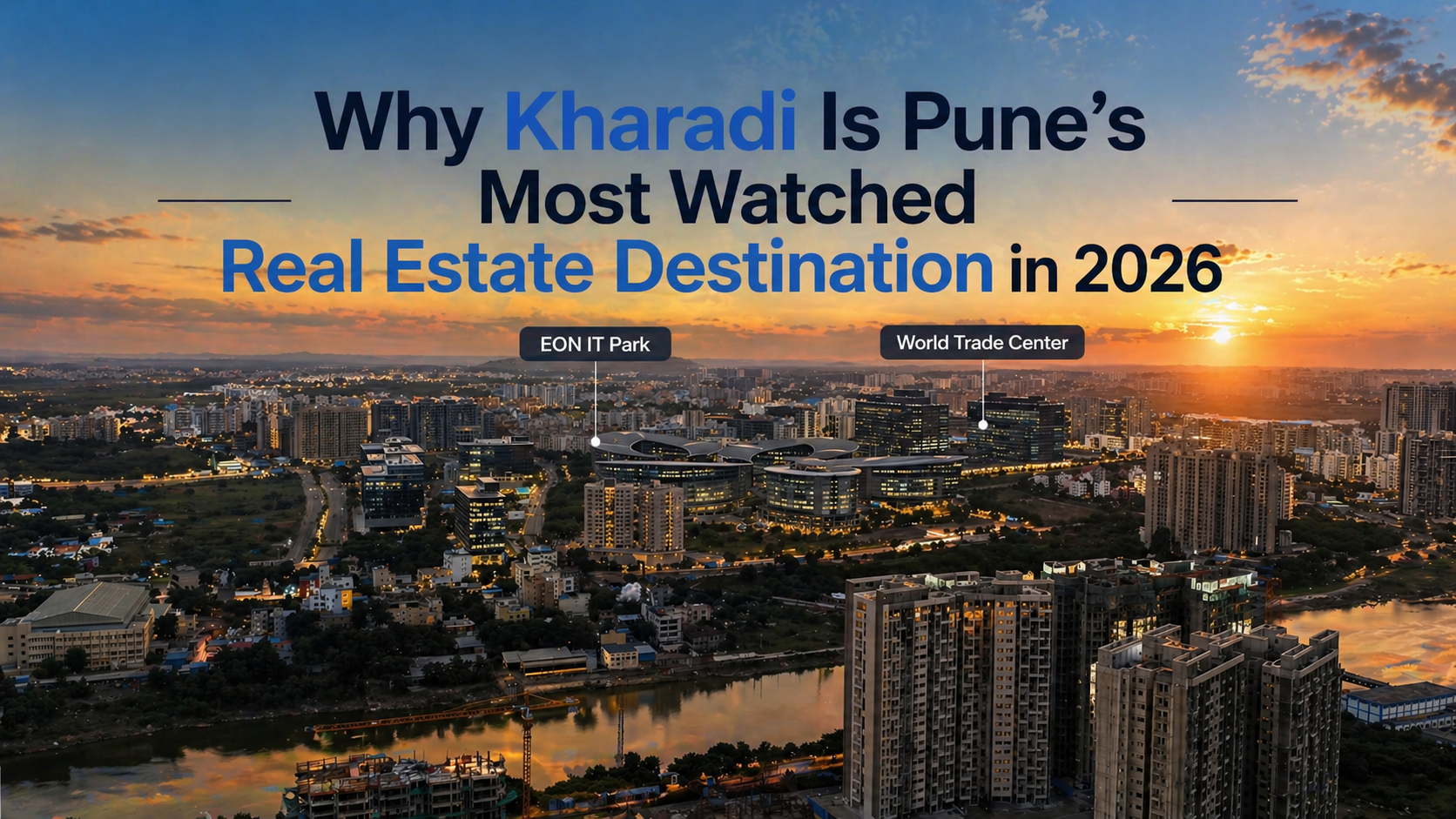
Introduction: Why Kharadi Is Pune's Most Watched Real Estate Destination in 2026
If there is one micro-market in Pune that consistently outperforms expectations, it is Kharadi. Tucked in the eastern corridor of Pune, this neighbourhood has undergone a transformation so dramatic over the last decade that it now ranks among Maharashtra's most sought-after real estate investment destinations — and 2026 is shaping up to be its most consequential year yet.
What began as a fringe industrial zone has evolved into a mature, mixed-use urban hub driven by the convergence of three powerful forces: a booming IT ecosystem, relentless infrastructure investment, and a rapidly expanding residential catchment of educated, high-income professionals. The result is a real estate market that offers something rare in today's environment — both stability and upside.
For property investors, NRIs evaluating Indian assets, IT professionals seeking proximity to work, and first-time homebuyers calibrating their decisions against long-term value, Kharadi presents a compelling, data-backed case. This report analyses where the market stands today, what drives it, and where it is heading through 2030.
1. Kharadi Real Estate: A Micro-Market Overview
Location Advantage
Kharadi occupies a strategic position on the eastern flank of Pune, bordered by Wagholi to the north, Mundhwa to the south, Viman Nagar to the west, and Hadapsar to the southwest. This geography places it within easy reach of Pune's two largest employment nodes — the eastern IT corridor and the Pune Airport zone.
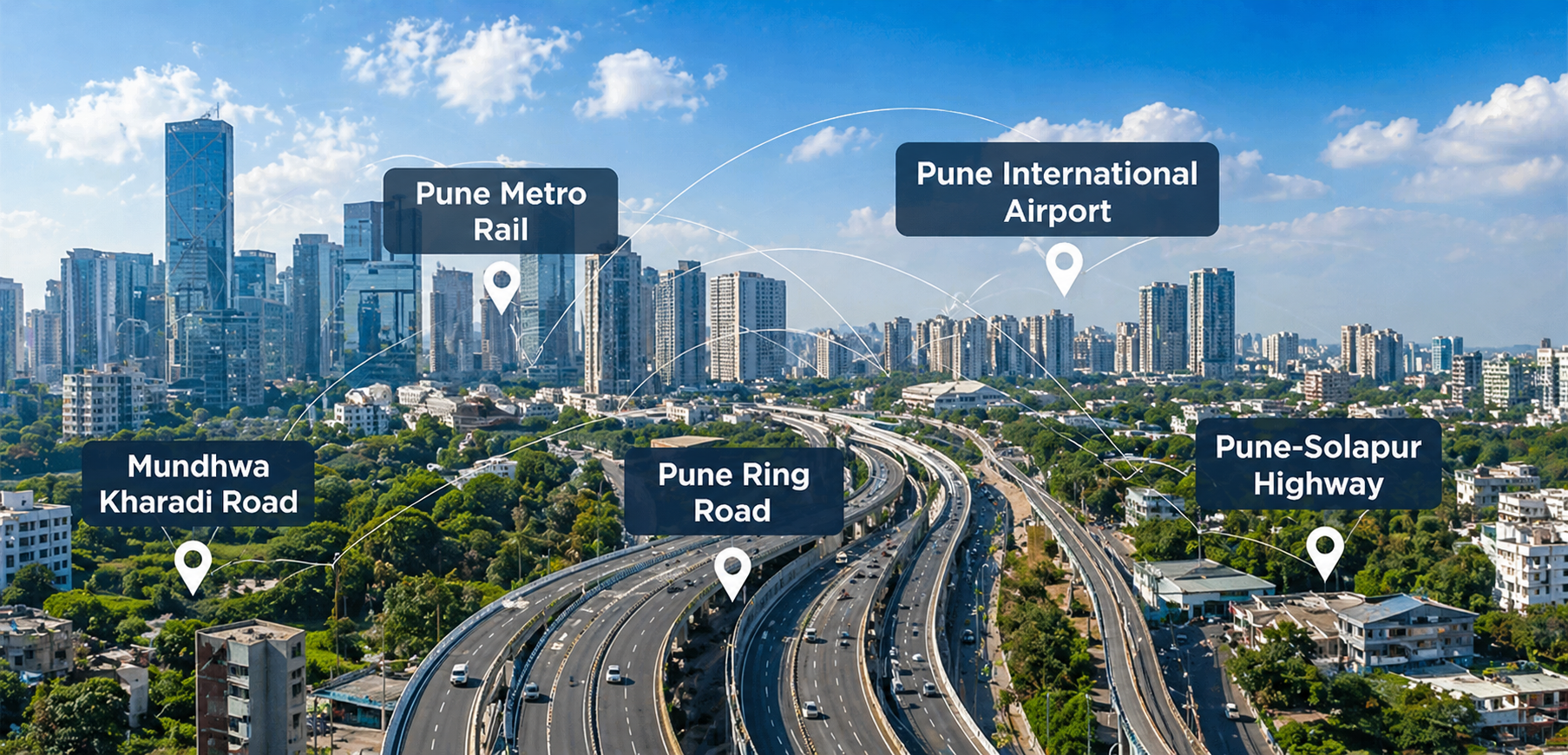
The locality sits along the Pune-Nagar Road (NH-753F) and benefits from direct access to the Pune Ring Road, making intra-city and inter-city commuting relatively frictionless — a factor that consistently elevates residential demand in Indian metros.
Demand Drivers at a Glance
- Employment proximity: EON IT Park and World Trade Centre Pune are within 2–4 km
- Social infrastructure: Reputed schools (Bishop's School, Podar International), hospitals (Columbia Asia, Sahyadri), and retail hubs (Phoenix Marketcity, Seasons Mall) are all accessible within 5–10 km
- Rental absorption: High floating population of IT professionals creates sustained rental demand
- Developer confidence: Major national and Pune-based developers have maintained active project pipelines in the micro-market
Micro-Market Positioning
Within Pune's broader residential landscape, Kharadi sits in the mid-to-premium tier — above Wagholi and Hadapsar in pricing and brand positioning, roughly comparable to Viman Nagar, and just below Koregaon Park and Kalyani Nagar in the luxury bracket. This positioning is significant: it means Kharadi captures demand from multiple buyer segments simultaneously, which insulates it from sharp cyclical corrections.
2. Current Property Prices in Kharadi (2026)
Understanding prevailing price points is foundational to any investment decision. The following data reflects market-observed trends and analyst estimates for Kharadi as of early 2026.
Average Price Per Square Foot
| Segment | Price Range (₹ per sq ft) |
|---|---|
| Affordable / Mid-Segment | ₹7,500 – ₹9,500 |
| Premium Residential | ₹9,500 – ₹12,500 |
| Luxury / Ultra-Premium | ₹12,500 – ₹16,000+ |
Configuration-Wise Pricing
| Configuration | Size Range (sq ft) | Price Range (₹) |
|---|---|---|
| 2 BHK | 850 – 1,100 | ₹75 lakh – ₹1.10 crore |
| 3 BHK | 1,200 – 1,600 | ₹1.15 crore – ₹1.85 crore |
| 3 BHK Luxury | 1,600 – 2,200 | ₹1.90 crore – ₹3.00 crore |
| 4 BHK / Penthouse | 2,500+ | ₹3.50 crore – ₹6.00 crore |
Appreciation Rate Analysis
Kharadi has delivered consistent capital appreciation of 8–10% year-on-year in the mid-premium segment over the 2021–2025 period, with select premium projects touching 12–14% appreciation in years of strong employment absorption. This outperforms the Pune city average of 6–8% CAGR for the same period.
The appreciation trajectory is supported by shrinking inventory-to-sales ratios — a reliable leading indicator of price firmness. As of Q4 2025, unsold inventory in Kharadi had declined to approximately 14–18 months of absorption, compared to the Pune-wide average of 22–24 months, signalling a healthier supply-demand equilibrium.
3. IT Hub Growth: The Engine Powering Kharadi's Property Demand
No analysis of Kharadi real estate is complete without a thorough examination of its employment ecosystem. The IT sector is not merely a background factor here — it is the central, structural driver of both capital appreciation and rental income.
EON IT Park
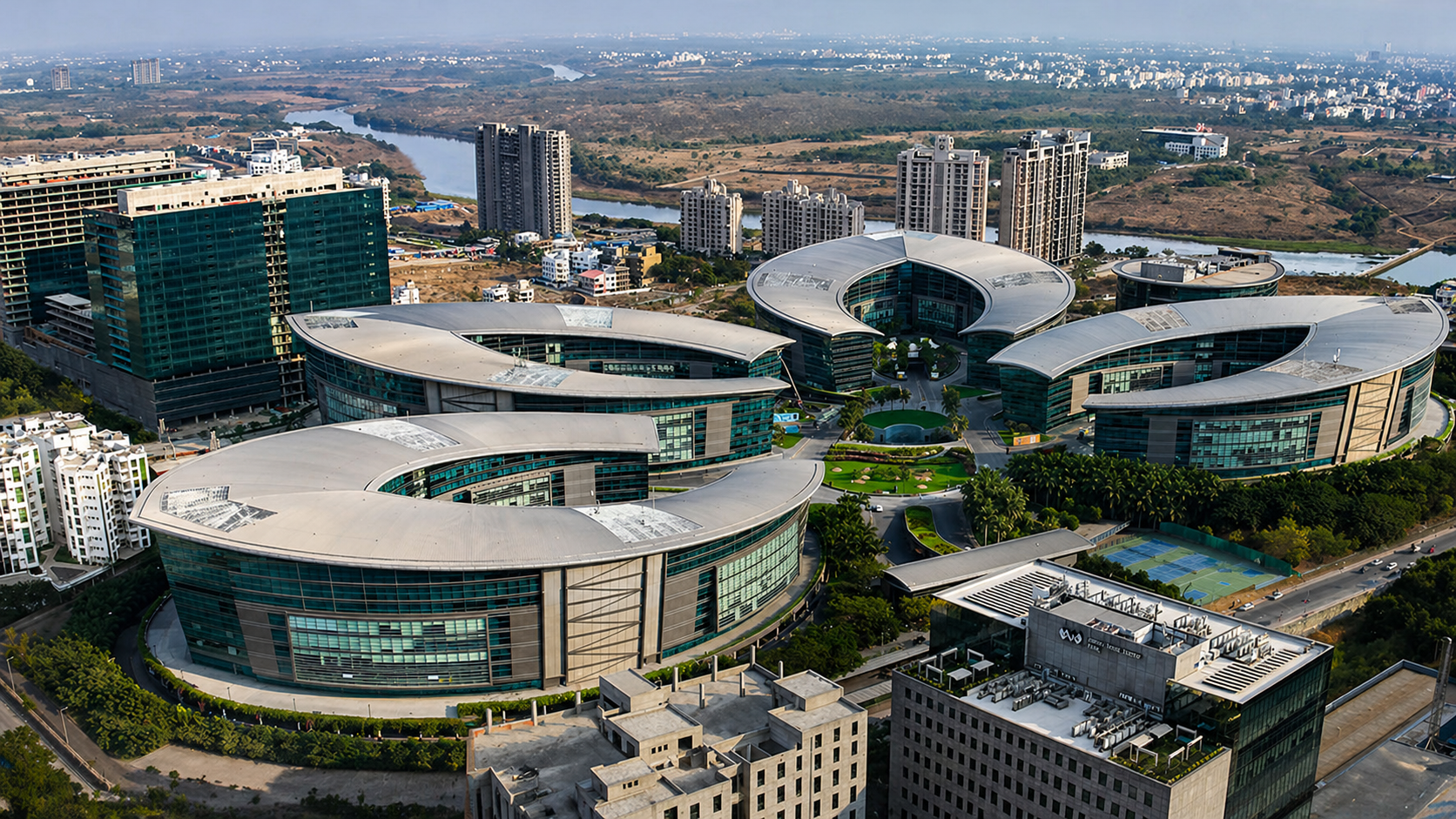
EON IT Park, spanning approximately 5 million square feet across multiple towers on Kharadi Bypass Road, is one of Pune's largest IT parks. It houses global tenants including Citibank, Wipro, Cognizant, and numerous mid-sized technology firms. The park employs an estimated 60,000–70,000 professionals, a substantial percentage of whom seek residential accommodation within a 5–7 km radius.
World Trade Centre Pune
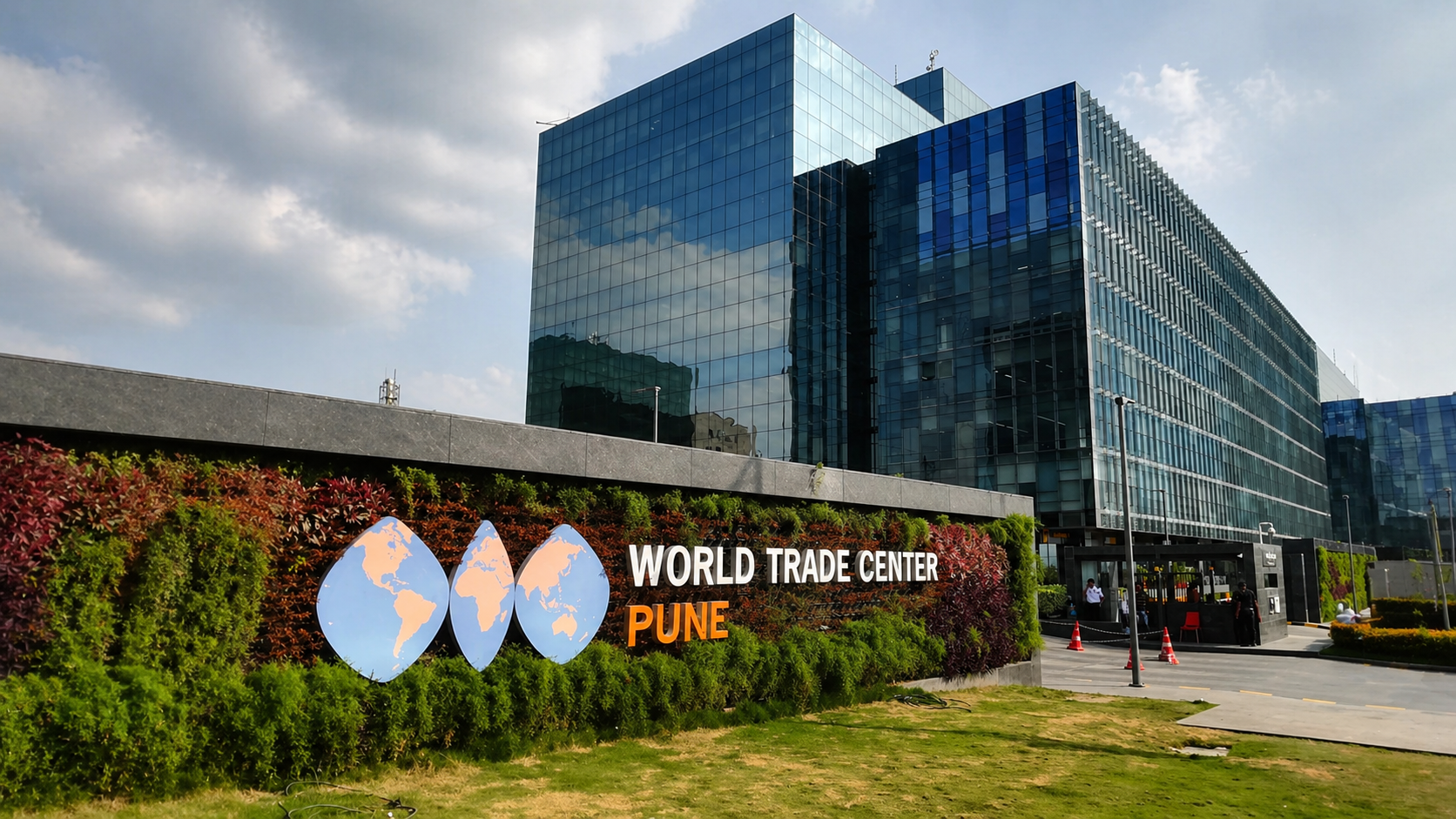
The World Trade Centre Pune, located in close proximity to Kharadi, adds another layer of commercial absorption. Its mixed-use format — combining office space, retail, and hospitality — has attracted both MNC offices and domestic corporate headquarters, further diversifying the employment base.
Employment Migration Effect on Real Estate
The concentration of IT and ITES employment in the Kharadi-Hadapsar belt creates a sustained migration of educated professionals aged 25–40 into the micro-market. This demographic group is characterised by:
- Above-average household incomes (₹12–35 lakh per annum)
- High propensity to rent in the short term and buy within 3–7 years
- Preference for proximity to workplace over price optimization
- Sensitivity to quality of social infrastructure and lifestyle amenities
This profile generates both immediate rental demand and medium-term end-user purchasing demand — a dual dynamic that sustains property values across cycles.
Sectoral Expansion Outlook
India's IT sector, despite global headwinds in 2023–2024, has stabilised and is expected to add significant headcount through 2026–2028, driven by AI services, cloud infrastructure, and digital transformation projects. Pune, as India's second-largest IT city, is positioned to absorb a meaningful share of this growth, and Kharadi — with its established campus infrastructure — is among the primary beneficiaries.
4. Infrastructure Developments Transforming Kharadi
Infrastructure is the multiplier that converts locational potential into property price realisation. Kharadi's infrastructure trajectory is among the most robust of any Pune micro-market.
Pune Metro Connectivity
The Pune Metro's Line 1 (PCMC to Swargate) and the proposed Ring Road Metro corridor have significant implications for eastern Pune. The metro extension towards Hadapsar and the eastern corridor — with Kharadi-adjacent stations planned — is expected to reduce commute times to central Pune by 30–40%, unlocking residential demand from buyers who previously avoided the area due to traffic congestion.
Metro connectivity, historically, has driven 10–18% property price appreciation in a 500m–1km catchment zone in Indian cities. Kharadi's positioning for such a catalyst makes current entry points particularly attractive.
Pune Ring Road & Airport Accessibility
The Pune Ring Road project, spanning approximately 170 km, will directly pass through the eastern Pune corridor. This arterial connection will dramatically reduce travel times between Kharadi and key destinations including Hinjewadi (western IT hub), Talegaon (industrial zone), and the upcoming Purandar Greenfield Airport.
Pune's existing Lohegaon International Airport is approximately 6–8 km from Kharadi — one of the closest distances between any Pune residential hub and the airport. This is a material advantage for senior executives, NRI homeowners, and business travellers. The airport handles over 100 direct domestic routes and several international connections, making Kharadi's proximity a functional lifestyle benefit.
The proposed Purandar Greenfield Airport, while longer-term (projected 2030+ timeline), adds a future infrastructure narrative that sustains developer and investor interest in eastern Pune broadly.
Road Infrastructure Upgrades
- Kharadi Bypass Road widening and signal-free corridor development
- Magarpatta-Kharadi connector improvements reducing east-west intra-city travel times
- Inner Ring Road improvements connecting Kharadi with Kalyani Nagar and Koregaon Park
5. Rental Market & Yield Analysis
For investors, rental yield is often the more immediate financial metric — and Kharadi performs strongly here.
Rental Demand Profile
The tenant base in Kharadi is overwhelmingly IT professionals, with a secondary component of hospitality and retail sector workers. This yields several favorable rental market characteristics:
- Low vacancy risk: IT professionals prioritise proximity to work; the EON park ecosystem ensures a near-permanent reservoir of tenants
- Higher than average rent levels: Premium amenities, RERA-compliant projects, and branded developments command above-market rents
- Long lease tenures: Corporate lease arrangements (companies leasing for employees) are common, offering 2–3 year lease terms
Rental Rate Data (2026 Estimates)
| Configuration | Monthly Rental Range | Annual Rental Income |
|---|---|---|
| 2 BHK (850–1,000 sq ft) | ₹22,000 – ₹32,000 | ₹2.64L – ₹3.84L |
| 3 BHK (1,200–1,500 sq ft) | ₹35,000 – ₹52,000 | ₹4.20L – ₹6.24L |
| 3 BHK Luxury | ₹55,000 – ₹85,000 | ₹6.60L – ₹10.20L |
Gross Rental Yield
| Segment | Gross Rental Yield |
|---|---|
| Mid-segment 2 BHK | 3.8% – 4.5% |
| Premium 3 BHK | 3.5% – 4.2% |
| Luxury | 3.2% – 4.0% |
6. Demand Analysis: 2 BHK vs 3 BHK Homes
2 BHK: The Market's Workhorse
The 2 BHK remains the highest-volume configuration in Kharadi, accounting for an estimated 55–60% of all transactions. Its dominance is structural:
- IT professional demand: Singles and young couples prioritise proximity and size efficiency over space
- Affordability threshold: ₹75 lakh – ₹1.10 crore hits a sweet spot for buyers leveraging home loans at ₹50–70 lakh
- Investor liquidity: 2 BHK units are far easier to rent and exit than larger configurations
- First-time buyer appeal: EMIs at prevailing rates (8.5–9%) for a ₹80 lakh loan remain manageable on dual IT incomes
3 BHK: Rising End-User Preference
The 3 BHK segment has gained significant momentum post-pandemic, driven by:
- Hybrid and work-from-home arrangements increasing space requirements
- Growing nuclear families requiring a dedicated study or home office
- Lifestyle upgrading among senior IT professionals (8–15 years' experience) buying their second or third home
- NRI buyers preferring larger configurations for occasional use with rental income potential
7. The Rise of Luxury & Premium Projects in Kharadi
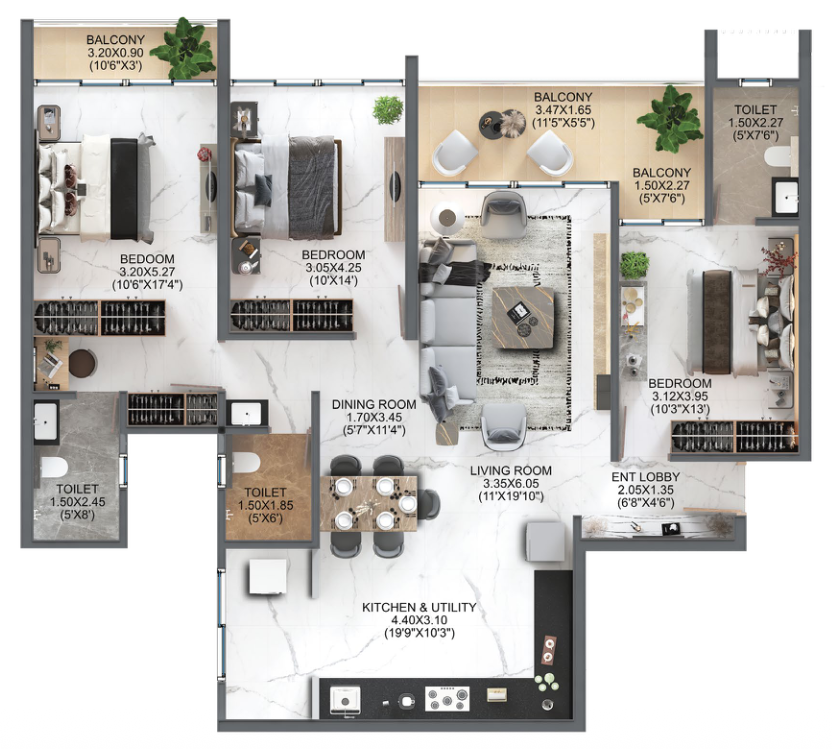
A structural shift is underway in Kharadi's project mix. Through 2019, the market was dominated by mid-segment developments. From 2021 onwards, premium and luxury launches have grown substantially, reflecting both rising incomes and changing lifestyle aspirations.
What Is Driving the Premium Shift?
- IT salary inflation: Senior technology professionals in Pune earn ₹30–80 lakh annually, with significant disposable capacity for aspirational real estate.
- Lifestyle expectations: Amenities like rooftop pools, co-working spaces, EV charging infrastructure, concierge services, and green certifications have become standard.
- Brand migration: Leading national developers (Godrej, Mahindra Lifespaces, Kolte Patil, Shapoorji Pallonji) have strengthened their pipeline here.
8. ROI & Investment Calculations
To ground the analysis in concrete financial terms, consider the following illustrative scenarios.
Scenario A: Mid-Segment 2 BHK Investment
| Purchase Price | ₹85,00,000 |
| Down Payment (20%) | ₹17,00,000 |
| Home Loan (7.5% for 20 yrs) | ₹68,00,000 |
| Monthly EMI | ₹54,600 (approx) |
| Monthly Rental Income | ₹26,000 |
| Net Monthly Cash Outflow | ₹28,600 |
| Capital Value at 9% CAGR (5 years) | ₹1,30,75,000 |
| Capital Gain in 5 Years | ₹45,75,000 |
| Total Rental Income (5 years) | ₹15,60,000 |
| Total Return | ₹61,35,000 |
Scenario B: Premium 3 BHK Investment
| Purchase Price | ₹1,60,00,000 |
| Down Payment (25%) | ₹40,00,000 |
| Monthly Rental Income | ₹50,000 |
| Capital Value at 10% CAGR (5 years) | ₹2,57,70,000 |
| Capital Gain (5 years) | ₹97,70,000 |
| Total Rental Income (5 years) | ₹30,00,000 |
| Combined Return | ₹1,27,70,000 |
These are illustrative projections based on prevailing market assumptions. Actual returns are subject to market conditions, financing costs, maintenance expenses, and vacancy periods.
9. Future Real Estate Forecast: 2026–2030
Price Projections
| Year | Estimated Average Price (₹/sq ft) | YoY Appreciation |
|---|---|---|
| 2026 | ₹9,500 – ₹10,500 | 8–10% |
| 2027 | ₹10,200 – ₹11,400 | 7–9% |
| 2028 | ₹10,900 – ₹12,400 | 7–8% |
| 2029 | ₹11,700 – ₹13,500 | 7–9% |
| 2030 | ₹12,500 – ₹14,800 | 8–10% |
(Mid-segment weighted average; premium projects may outperform by 200–300 bps)
Growth Expectations & Risk Factors
The structural case rests on three convergent trends: IT employment growth (digital economy reaching $1 trillion by 2028), infrastructure completion (Metro, ring road), and steady urbanisation demographics.
However, risks exist: A prolonged global tech slowdown, sustained high interest rates (above 9%), potential supply overhangs if developers over-launch, and historical infrastructure delays could dampen these projections.
10. Kharadi vs Other Pune Investment Destinations
| Parameter | Kharadi | Hinjewadi | Wakad | Baner | Viman Nagar |
|---|---|---|---|---|---|
| Avg Price (₹/sq ft) | ₹9,500–12,500 | ₹7,500–10,500 | ₹8,000–11,000 | ₹9,000–13,000 | ₹10,000–14,000 |
| Rental Yield | 3.8–4.5% | 3.5–4.2% | 3.5–4.0% | 3.2–3.8% | 3.0–3.5% |
| Airport Proximity | ★★★★ | ★ | ★★ | ★★ | ★★★★★ |
| Metro Access | Upcoming | Upcoming | Upcoming | Partial | Operational |
| IT Emp. Density | Very High | Very High | High | Moderate | Moderate |
Key Insight: Kharadi offers Viman Nagar-level location quality at a meaningful price discount, with superior IT employment proximity versus Baner and a stronger infrastructure trajectory than Wakad or Wakad-adjacent areas.
11. Expert Investment Tips for Kharadi Property in 2026
- Prioritise Ready-to-Move or Near-Completion Projects: They command a premium but eliminate execution risk, deliver immediate rental income, and sidestep GST implications.
- Focus on the ₹90 Lakh – ₹1.50 Crore Band: This bracket captures maximum demand from IT professional end-users and investors simultaneously, ensuring high liquidity.
- Evaluate Developer Track Record Rigorously: Scrutinise the developer's delivery history, project quality scores, and litigation records. Branded developers in Kharadi typically deliver superior appreciation.
- Ideal Holding Period: 5–7 Years: This allows investors to capture full appreciation cycles, benefit from infrastructure upgrades, and optimise capital gains tax treatment.
- Consider NRI-Friendly Managed Properties: For overseas investors, properties offering professional property management or guaranteed rental agreements dramatically reduce the operational burden.
- Watch Pre-Launch Windows for Premium Projects: The price gap between pre-launch and post-OC market price in the premium segment has historically been 18–25%.
12. Conclusion
The Kharadi real estate market in 2026 presents one of the more intellectually defensible investment propositions in Indian residential real estate. Its thesis rests not on speculation or promotional narratives but on converging structural factors: a dense, growing IT employment base, a rapidly improving infrastructure matrix, a disciplined but dynamic supply pipeline, and a residential demand profile dominated by high-income professionals with both the means and the motivation to pay for quality.
Prices have appreciated meaningfully from their pre-pandemic base but remain below the levels that would suggest bubble-like overvaluation. Rental yields are competitive for the asset class and are likely to improve as the IT employment base deepens. The infrastructure developments — metro, ring road, airport connectivity — are now moving from planning to execution phases, suggesting that the full pricing premium they will eventually command has yet to be built into the market.
For investors with a medium-to-long-term horizon, for NRIs seeking a productive Indian asset allocation, for IT professionals making their first or second property purchase, and for homebuyers who want a liveable, appreciating community with world-class connectivity — Kharadi in 2026 merits serious, careful consideration.
As with any real estate investment, due diligence, legal verification, and independent financial advice remain essential. The market provides the opportunity; informed decision-making determines the outcome.